

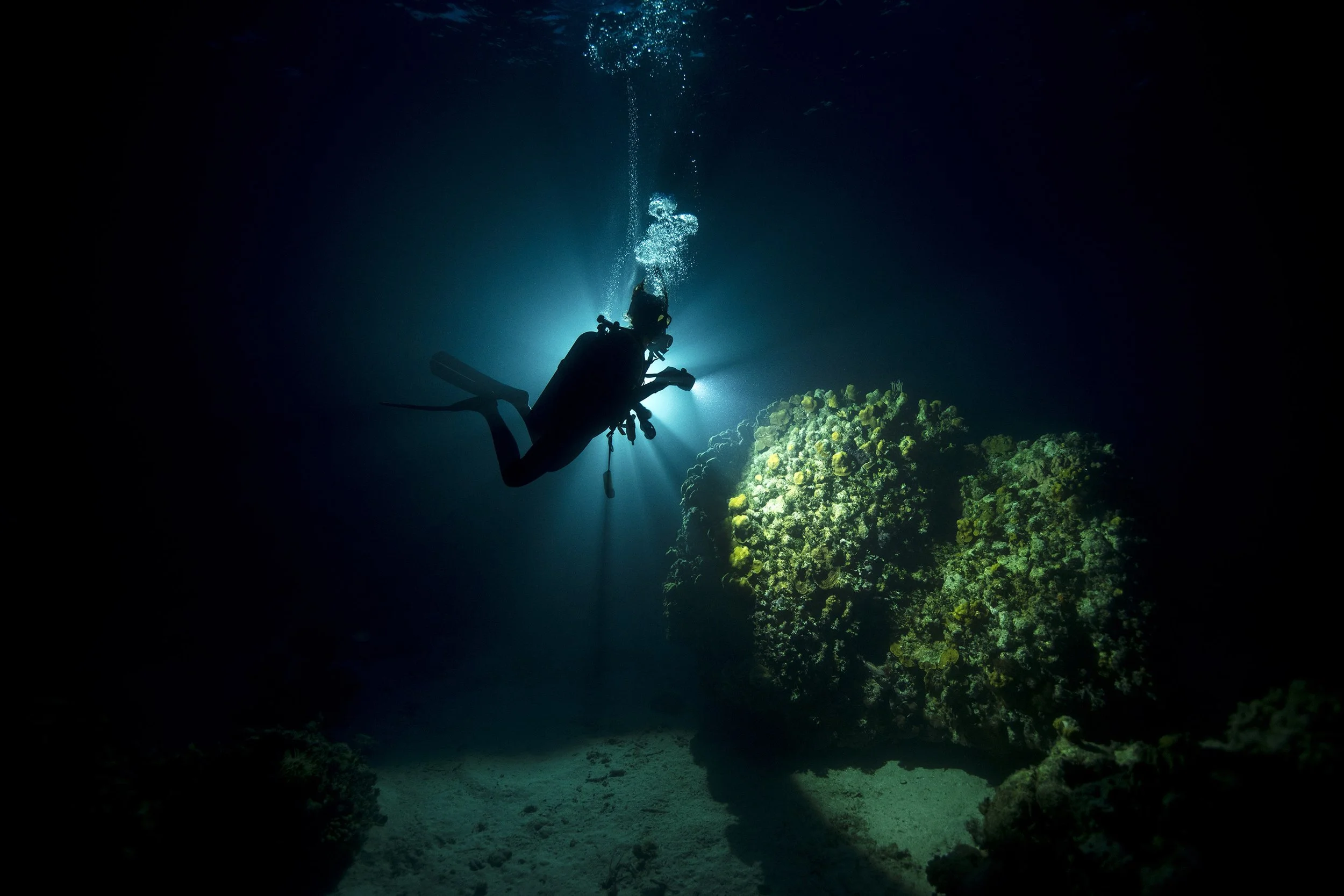
NIGHT DIVING COURSE IN FRANKFURT
Your PADI Night Diver Course — the same lake, a different body of water
Price: €229 — includes e-learning, tank, refills, lights, and certification
Duration: Three dives after dark
Prerequisite: PADI Open Water Diver or an equivalent certification
Minimum age: 12 years
Certification: PADI Night Diver — recognized worldwide, valid for life
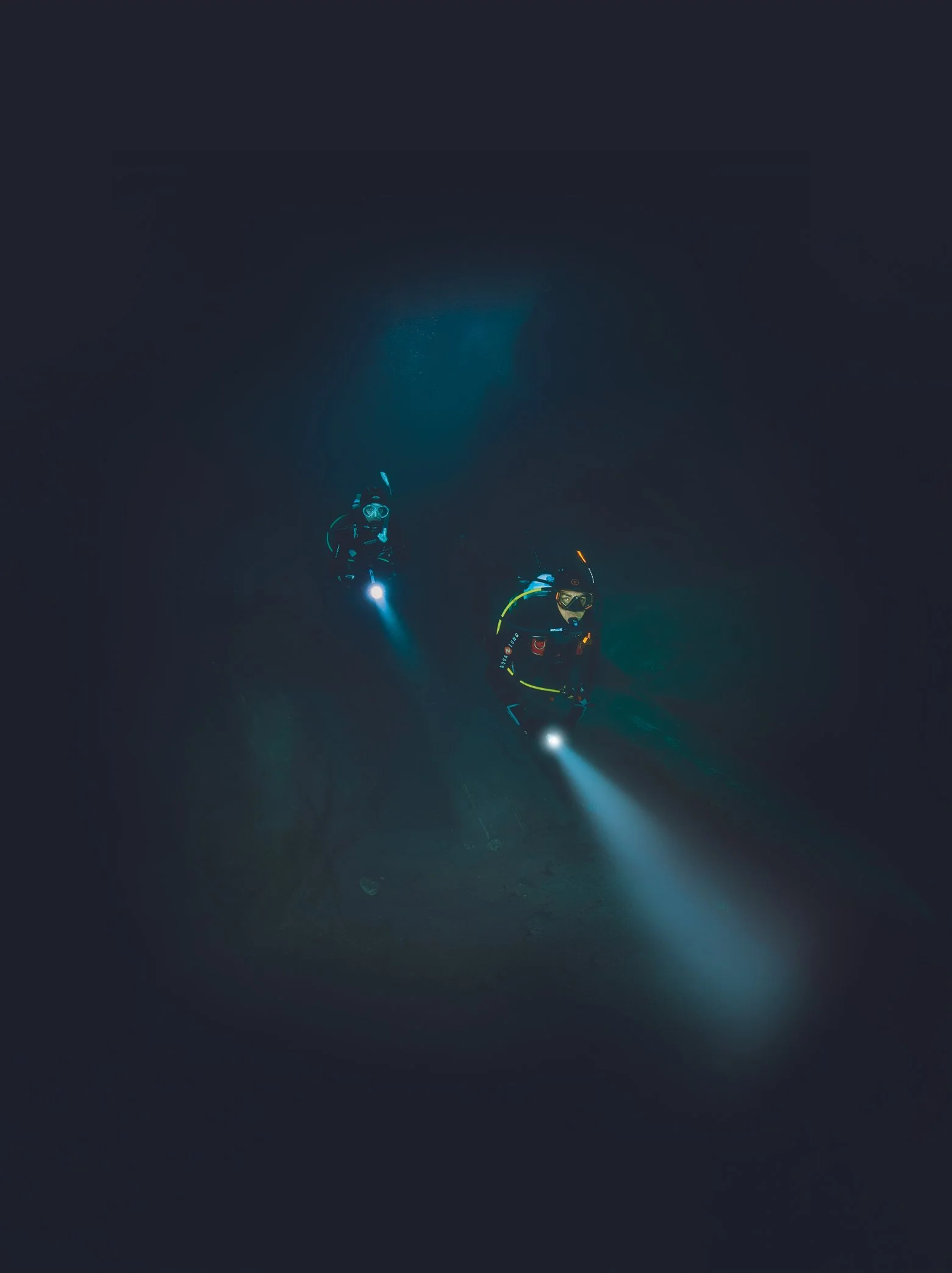

The same lake that looks green and unremarkable during the day is a different body of water at night. Crayfish emerge from their burrows, fish float asleep in the open water, and in the beam of your flashlight, the colors return—colors that disappear during the day once you’re just a few meters out.
The second point is less romantic, but more important: night diving means diving with limited visibility. Orientation, staying in contact with your dive partner, and ascent control work differently than they do in daylight.
Over the course of three dives, you'll learn to dive in the dark in a way that fosters calm rather than tension. After that, a night dive will feel just like any other dive—only with more fascinating marine life.
What to expect
PADI e-Learning in Advance
Equipment and lighting, light signals, orientation in the dark, what to do if your light fails, and planning a night dive. Two to three hours, flexible scheduling, permanent access.
Lamps and Light Signals
Underwater, the lamp becomes a means of communication. You'll learn the light signals—and how not to shine the light directly into your partner's eyes, which takes more practice than it sounds.
Partner Contact and Navigation
Fixed distance, positioning, and the procedure to follow if contact is lost. Also, navigating using a compass, time, and depth rather than by looking at the shore.
Light Bulb Failure
You'll practice switching to the backup light and making a controlled ascent. That's why no one dives at night with just one light.
Observe Instead of Searching
Part of the third dive is all about why you're doing this in the first place: floating slowly and seeing what happens in the beam of light. After that, you'll be a PADI Night Diver, and you'll receive your digital certificate right away.
What's Included in the Price
Includes:
PADI e-Learning “Night Diver” — Lifetime Access
Three course dives with a PADI instructor in small groups
Bottle and Contents
Diving Lights — We provide the main and backup lights for the course
Port Fees
Digital Licensing Card and Licensing Fees
Not included:
Your diving gear. You’ll need to bring your own jacket, regulator, and wetsuit—or you can book the rental equipment package for 80 €.
ABC gear: mask, snorkel, fins, footies.
You don't need your own lamp for the course. If you plan to dive at night regularly afterward, you can get honest advice at the shop.
Requirements
PADI Open Water Diver certification or an equivalent certification. We accept certifications from other organizations.
Minimum age: 12 years.
There's no minimum number of dives —but the course is more enjoyable if you already feel confident by the end of the day.
PADI Pre-Course Medical Questionnaire — Required for every diving course.
A medical certificate of fitness for diving if we’re diving at Hunsfels. The lake requires this from every diver, without exception; at Kronau, it’s not necessary. Any doctor can issue it, including your family doctor. To be on the safe side, get it in advance.
If you feel uncomfortable underwater before dark, you're not alone. The first dive begins at dusk—for most people, that feeling goes away during the second dive.
Night Diving in Frankfurt and the Rhine-Main Region
We hold our theory sessions and equipment training in Frankfurt-Schwanheim, at Vogesenstraße 12C. Customer parking is available behind the building (entrance at Am Kirchholz 12); to get here, take the A5 and then Schwanheimer Bahnstraße. It takes 15 to 20 minutes from Sachsenhausen, Niederrad, and Höchst, and a good half hour from Offenbach, Rüsselsheim, Hanau, and Bad Homburg.
Diving takes place in the region’s lakes, which have easily accessible entry points. This is where the German winter is an advantage: From November through February, it gets dark around 5 p.m., so you’ll be back home at a reasonable hour—and the lakes are often clearer in winter. To combat the cold, there’s the dry suit diving course.
Why the Frankfurt Dive Center
Lights are included. We'll provide the main light and a spare—you don't need to buy anything in advance.
Small groups — not an option at night. In the dark, an instructor can only reliably keep an eye on a few divers.
Reasonable times. We schedule the appointments during the darker months and in the early evening.
Then we'll continue. Via the FDC Club , there are regular night dives.
What comes after the night dive course?
These go well with it: UNDERWATER NAVIGATION, since navigation at night relies on a compass anyway, and the PERFECT BULKHEAD CONTROL. If you want to dive in the winter, the DRY SUIT COURSE .
It counts as one of the five specialties required to become a Master Scuba Diver—the five specialties plus certification cost €999 as a bundle.
You can find all specialties under SPECIALTIES, and all prices in the PRICE LIST.
Ready for the next step?
We’ll give you personalized advice—the best next course for you depends on your experience and goals. Give us a call or send us a message.
FAQ
-
229 euros. This includes e-learning, three dives, a tank, refills, lake fees, lights, and certification. The rental equipment package costs an additional 80 euros.
-
No. We provide the main and backup lights for the course. It’s only worth getting your own once you start diving regularly at night afterward.
-
Preferably during the winter months. From November through February, it gets dark around 5:00 p.m., so we start in the early evening.
-
Three. The first begins at dusk; the other two begin in complete darkness.
-
For many people, this happens right from the start, and that's normal. That's why we set out at dusk and stay close together in small groups.
-
That's exactly what we practice. You always carry a spare lamp with you and learn how to switch it out and ascend safely.
-
There is often more light in the beam than during the day, because artificial light brings out the colors. In winter, the lakes are also usually clearer.
-
Ages 12 and up, with an Open Water Diver, Junior Open Water Diver, or equivalent certification.