

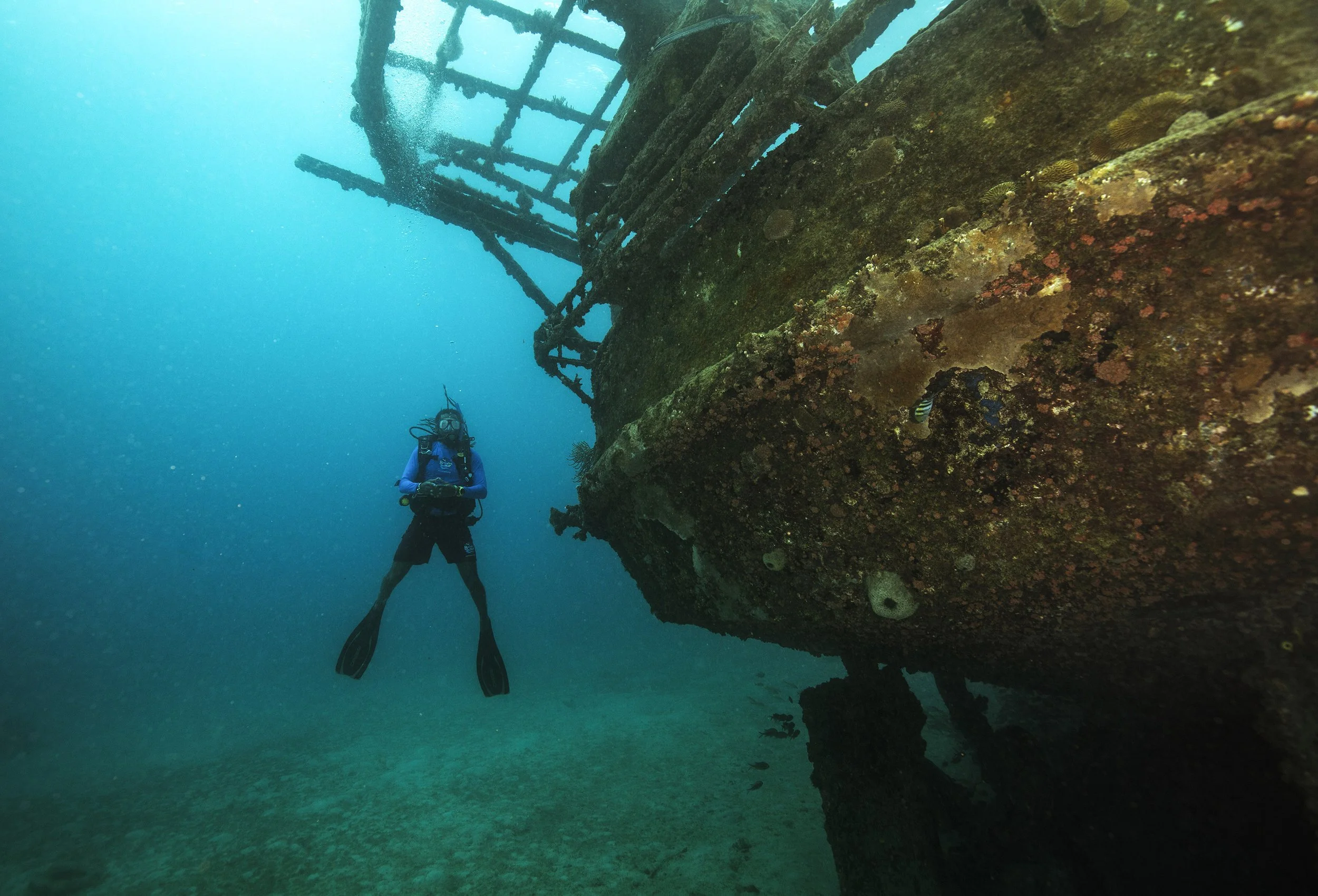
WRECK DIVING COURSE IN FRANKFURT
Your PADI Wreck Diver Course — Explore Wrecks Safely
Price: 249 € — includes e-learning, a tank, refills, and certification
Duration: Four dives, usually over two days
Prerequisite: PADI Adventure Diver or Advanced Open Water Diver
Minimum age: 15 years
Certification: PADI Wreck Diver — recognized worldwide, valid for life
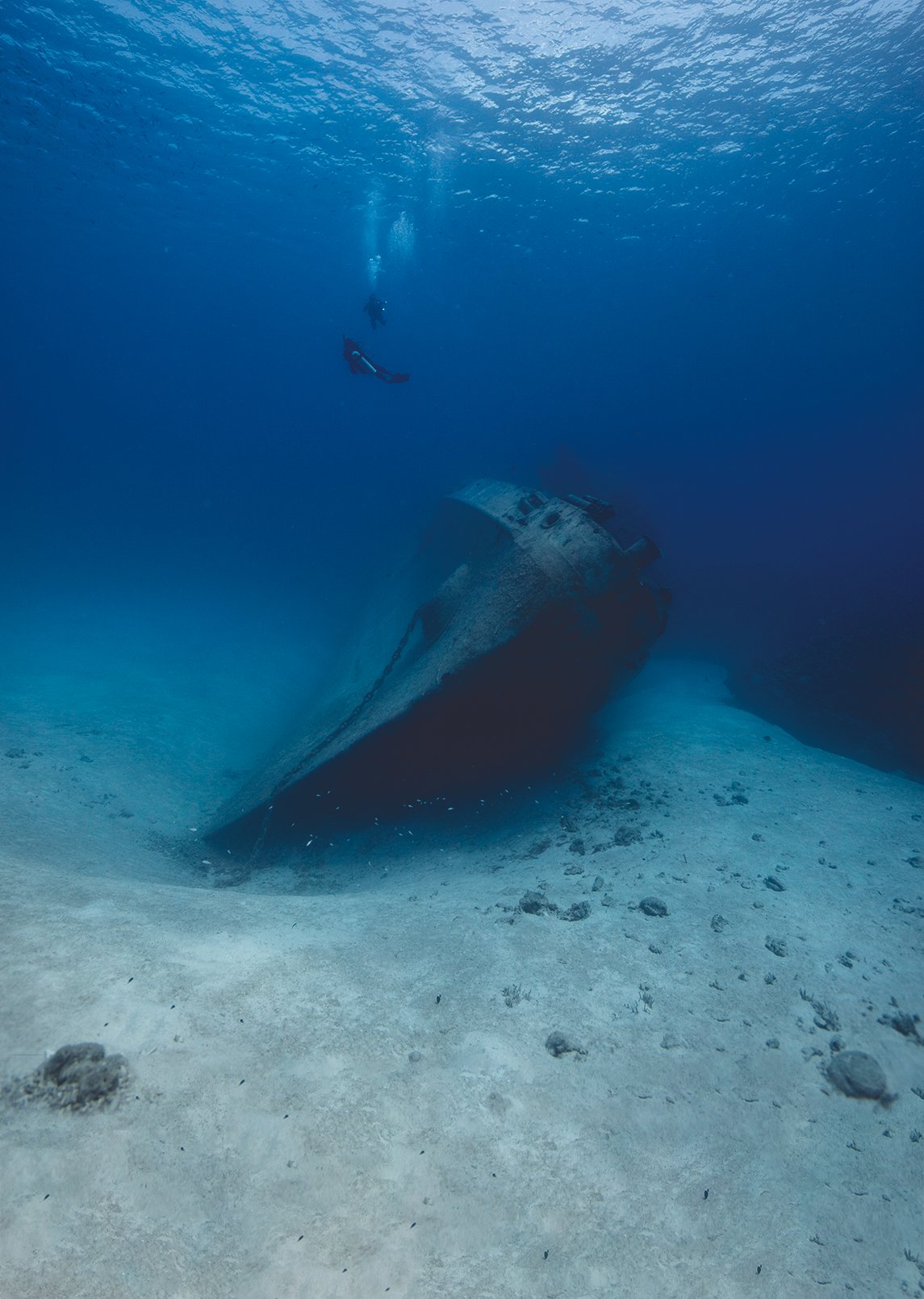

For many, shipwrecks are the very reason they dive in the first place. A ship on the seafloor is a reef, a time capsule, and a structure all at once—and the place where many experience their first truly unpleasant situation: stirred-up sediment, zero visibility, and steel overhead.
The PADI Wreck Diver course combines enthusiasm with the necessary skills: exploring systematically, laying lines, avoiding sediment, and identifying hazards.
And you'll learn where the limits are: This course qualifies you to dive on and around wrecks within an area with a view of open water—not for deep penetration.
What to expect
PADI e-Learning in Advance
Shipwrecks as cultural heritage, risk assessment, equipment, line management, and dive planning. Three to four hours, flexible scheduling, permanent access.
Explore and Map
You'll get a sense of the object yourself—its location, dimensions, entry and exit points—and draw a sketch.
Leash Handling
You lay a guide line, follow it, and find your way back even when visibility is poor. That is the core skill of the course.
Prevent Sedimentation and Identify Hazards
Use a fin-kicking technique close to the bottom, move slowly, and stay away from sharp edges, nets, and unstable structures.
Time and Air Budgets
Wrecks are often located at greater depths, and it's easy to lose track of time down there. After your fourth dive, you'll be a PADI Wreck Diver.
What's Included in the Price
Includes:
PADI e-Learning “Wreck Diver” — Lifetime Access
Four course dives with a PADI instructor in small groups
Bottle and Contents
Port Fees
Ropes, reels, marking materials, and lamps for the exercises
Digital Licensing Card and Licensing Fees
Not included:
Your diving gear. You’ll need to bring your own jacket, regulator, and wetsuit—or you can book the rental equipment package for 80 €.
ABC gear: mask, snorkel, fins, footies.
Requirements
PADI Adventure Diver, which in practice is usually the Advanced Open Water Diver. We accept equivalent certifications from other organizations.
Minimum age: 15 years.
PADI Diving Medical Questionnaire Before the course begins — standard for every diving course.
A medical certificate of fitness for diving if we’re diving at Hunsfels. The lake requires this from every diver, without exception; at Kronau, it’s not necessary. Any doctor can issue it, including your family doctor. To be on the safe side, get it in advance.
Something that isn't in the manual but is important: buoyancy control. If you can't move smoothly just above the sediment yet, practice master buoyancy control. It’s also a good idea to Deep Divercourse, because interesting wrecks are rarely found in shallow waters.
Wreck Diving in Frankfurt — An Honest Look
We hold our theory sessions and equipment training in Frankfurt-Schwanheim, at Vogesenstraße 12C. Customer parking is available behind the building (entrance at Am Kirchholz 12); to get here, take the A5 and then Schwanheimer Bahnstraße. It takes 15 to 20 minutes from Sachsenhausen, Niederrad, and Höchst, and a good half hour from Offenbach, Rüsselsheim, Hanau, and Bad Homburg.
There are no warships in the lakes of the Rhine-Main region. Instead, there are sunken objects—boats, vehicles, and structures. You can use them to practice everything that matters, even in conditions with poorer visibility than at sea. The real purpose of the course is in the Red Sea, the Mediterranean, and the Baltic Sea: you don’t want to be tying a line for the first time there.
Why the Frankfurt Dive Center
We don't stretch the course beyond its limits. The Wreck Diver course is not a free pass for penetration. We train according to PADI standards and clearly state where those standards end.
Small groups. At a site with limited visibility, an instructor cannot lead a large group.
Preparing for real-world goals. We tailor the course to where you actually want to travel.
Equipment that works. Ropes, pulleys, and lamps from our inventory, inspected before every class.
What comes after the Wreck Diver course?
The Wreck Diver course is most commonly combined with the DEEP DIVER and the UNDERWATER NAVIGATION. If you want to explore wrecks in the dark, take the NIGHT DIVING COURSE.
If you want to explore deep inside shipwrecks, you need technical training—find out everything you need to know on the page TECHNICAL DIVING COURSES.
It counts as one of the five specialties required to become a Master Scuba Diver—the five specialties plus certification cost €999 as a bundle.
You can find all specialties under SPECIALTIES, and all prices in the PRICE LIST.
Ready for the next step?
We’ll give you personalized advice—the best next course for you depends on your experience and goals. Give us a call or send us a message.
FAQ
-
249 euros. This includes e-learning, four dives, a tank, refills, lake fees, line materials, and certification. The rental equipment package costs an additional 80 euros.
-
Not shipwrecks in the traditional sense, but sunken objects that can be used to practice all the skills covered in the course—under conditions of poorer visibility than in the ocean.
-
For the Red Sea, the Mediterranean Sea, and the Baltic Sea. Many dive centers require a corresponding certification for wreck dives.
-
Only in accordance with PADI standards: limited, within the light zone, with a guide line. Deep penetration is technical diving.
-
Three to four hours of e-learning beforehand, followed by four dives, usually over two days.
-
PADI Adventure Diver certification (usually Advanced Open Water Diver) and a minimum age of 15. Stable buoyancy is more important than certification status.
-
Not for the course—we provide the lights. If you go wreck diving regularly afterward, you'll eventually need your own.
-
It's more challenging than a reef dive. If you follow the rules—leash, visibility range, avoiding sediment, and time limits—you can dive wrecks in a controlled and safe manner.