

PERFECT BALANCE
Your PADI Peak Performance Buoyancy Course in Frankfurt
Price: 259 € — includes e-learning, tank, tank fills, and certification
Duration: Two dives plus dry-land exercises, usually in one day
Prerequisite: PADI Open Water Diver or an equivalent certification
Minimum age: 10 years
Certification: PADI Peak Performance Buoyancy — recognized worldwide, valid for life
If you ask us which single specialty offers the most value to most divers, the answer is always the same: this one. Buoyancy is not just a specialty—it's the foundation of every single dive you'll ever make.
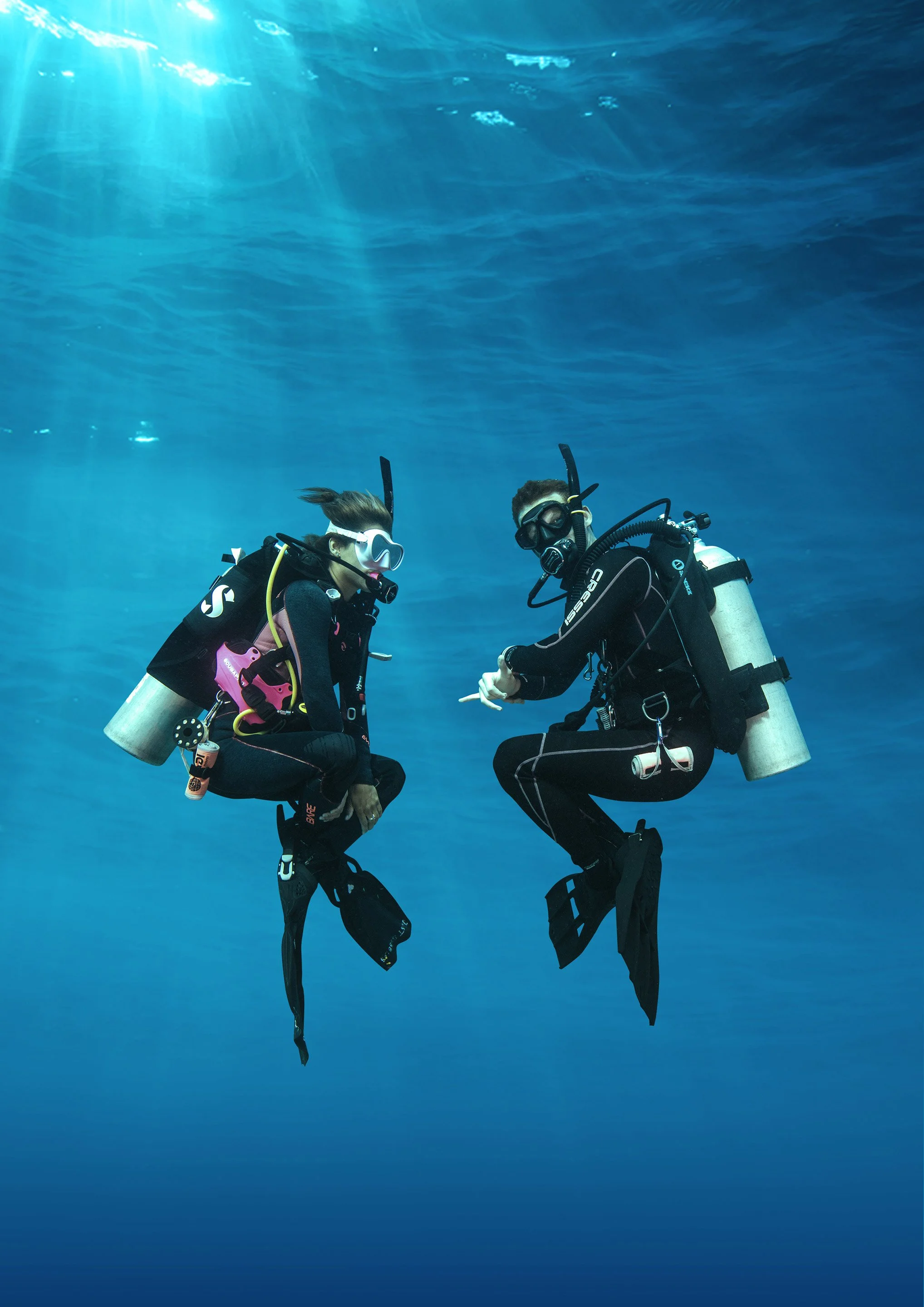
The difference is immediately visible in the water. One diver floats motionlessly above the bottom and observes calmly. The other paddles, sinks, kicks up sediment, pumps air into the BCD, rises too high — and surfaces after forty minutes with an empty tank. The difference isn't talent, but technique you can learn.
What to expect
Theory and dry runs
Why you float or sink: displacement, suit compression with depth, and the weight loss of your tank over the course of the dive. This explains why you struggle to descend at the beginning and can't hold your depth at five meters at the end.
Bleicheck — usually the biggest surprise
Almost everyone who joins this course dives with too much weights. Too much weights means more air in your BCD, more volume change with every depth change, and constant adjustments. We will recheck your weighting — provable, not by feel.
Trim and Weight Distribution
A horizontal trim isn't just about style. Divers who are angled push a part of their thrust upward with every fin kick. We shift weights, check tank positioning, and work on getting you horizontal effortlessly.
Two dives with real-world tasks
Hovering without moving your fins, fine-tuning your position through breathing, descending without touching the bottom, stopping your descent at a specific depth, and navigating an obstacle course where you’re not allowed to touch anything. At the end, you’ll have a weight log entry in your logbook—separate entries for fresh and saltwater.
What's Included in the Price
Includes:
PADI e-Learning for Peak Performance Buoyancy
Two dives with a PADI instructor in a small group
Tank and all fills
Pool or Lake Fees
Lead Protocol for Your Own Configuration
Digital Brevet Card
Certification Fees
Not included:
Your scuba gear. Bring your own BCD, regulator, and suit — or add the rental gear package for 80 €.
Basic gear (mask, snorkel, fins, dive boots).
A word of advice: If you have your own gear, be sure to bring it with you. A weight log for a rental jacket that you’ll never wear again isn’t much use to you.
Requirements
PADI Open Water Diver or an equivalent certification from another organization, such as CMAS or SSI.
Minimum age: 10 years.
There is no minimum number of dives. The course works just as well right after completing the Open Water Diver course as it does after three hundred dives.
PADI Diver Medical Questionnaire Before the course begins — standard for every diving course.
A medical certificate of fitness to dive if we’re diving at Hunsfels. The lake requires one from every diver, without exception; at Kronau, it’s not necessary. Any doctor can issue it, including your family doctor—you don’t need a diving physician. To be on the safe side, get it in advance, so you’ll be prepared for both lakes.
Buoyancy Control Course in Frankfurt and the Rhine-Main Region
We are located in Frankfurt-Schwanheim, at Vogesenstraße 12C. Customer parking is available behind the building (access via Am Kirchholz 12); to get here, take the A5 and Schwanheimer Bahnstraße. It takes 15 to 20 minutes from Sachsenhausen, Niederrad, and Höchst, and a good half hour from Offenbach, Rüsselsheim, Hanau, and Bad Homburg.
When it comes to buoyancy control, training in the pool at the Frankfurt Sports School is a real advantage: clear water, a defined depth, and no current. We conduct our open-water exercises at the lakes in the Rhine-Main region, where the soft bottom truly tests your buoyancy control—if you don’t stir up a cloud of sediment there, you’ve got your buoyancy under control.
Why the Frankfurt Dive Center
We see you. It’s only in small groups that you can really work on your buoyancy—someone floats right next to you and tells you what your left hand is doing.
Weights are no guessing game with us. In-house tank fill station, all suit types, and tank sizes available.
Then keep practicing. About the FDC Club , you’ll get in the water regularly. Your buoyancy control will improve the more you dive.
What comes after the buoyancy control course?
Peak Performance Buoyancy is one of the five specialties required to become a Master Scuba Diver and can be completed as an Adventure Dive on the ADVANCED OPEN WATER DIVER certification.
Good buoyancy control before the DEEP DIVER, wreck diving, drysuit diving, and underwater photography.
You can find all specialties under SPECIALTIES, and all prices in the PRICE LIST.
Ready for the next step?
We’ll give you personalized advice—the best next course for you depends on your experience and goals. Give us a call or send us a message.
FAQ
-
259 euros. This includes PADI eLearning, two dives with an instructor, tank, fills, pool or lake fees, and certification. The rental equipment package costs an extra 80 euros.
-
Usually yes. Anyone with solid buoyancy control is usually still diving with too much weight and poor trim. That's exactly where this course helps.
-
No, the tank and tank fills are included in the price. BCD, regulator, and suit are available as a package for 80 euros. Using your own gear will actually help you get more out of the course.
-
We don't promise any percentage. If you carry less weights, have less air in your BCD, and maintain a horizontal trim, you'll need to make significantly fewer corrections — lower gas consumption is simply the result.
-
Usually one day for the two dives and the dry-land exercises, plus one to two hours of e-learning beforehand.
-
No. The Open Water Diver certification is sufficient. In fact, taking the course right after that is especially effective.
-
Yes, as one of the five required specialties. If you're planning to do this, you should check out the bundle that includes five specialties and the Master Scuba Diver certification for 999 euros.